AI citation optimization is the work of making your website easy for AI search tools to find, understand and link to when they answer a question. It builds on SEO and does not replace it. The pages that get cited are indexed, clearly written, specific about who you are and where you work, and backed by a real reputation. We have worked on websites since 1998, and our AI search services cover Google AI Overviews, Google AI Mode, ChatGPT, Gemini and Perplexity, so this guide is written for owners who want their business named when a customer asks an AI tool for help.
Iwdesigners
iwdesigners.com
Help AI Search Find Your Business
IWD Marketing offers AI-driven search optimization and SEO to help businesses improve online visibility across AI search tools.
AI tools cite pages they can retrieve. If a page is not indexed or is blocked from the right crawler, it cannot be cited.
Google says optimizing for its generative features is still SEO: useful original content, clear structure and sound technical basics.
Specific, question-matching pages are cited more often than generic ones. A plumber in Jupiter needs a page on water heater replacement in Jupiter, not a page about plumbing in general.
No one can guarantee a citation. Measure with a fixed set of questions, your analytics and your search reports, then adjust.
For law firms, plumbers and contractors in Florida, the fastest gains come from fixing service pages, local details and technical access before writing anything new.
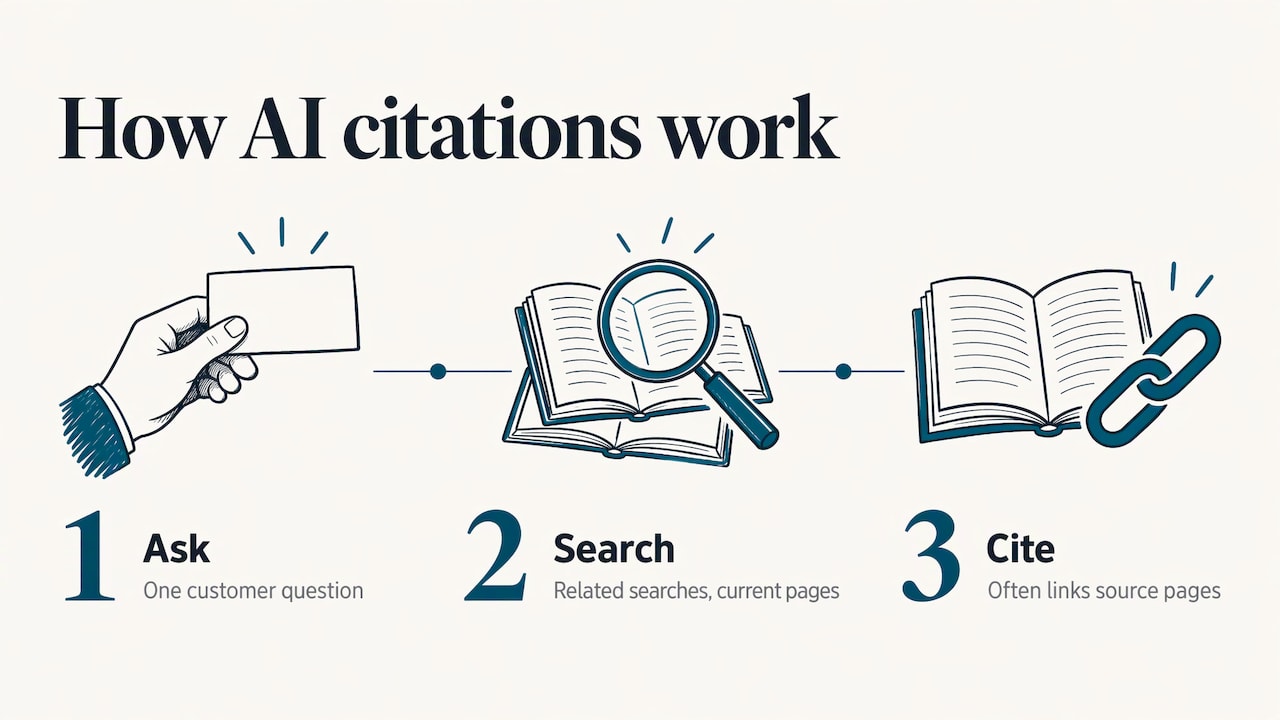
When someone asks ChatGPT, Perplexity or Google’s AI features a question, the tool writes an answer and often links to the pages it drew from. Those links are citations. Being cited puts your name and your link in front of a customer at the moment they are deciding.
This is not a separate discipline with its own secret rules. Google’s 2026 guide to generative AI features says its AI features use the Search index and its core ranking and quality systems, and that they use retrieval-augmented generation and query fan-out. In plain terms, the tool first retrieves relevant, current pages, and it runs several related searches behind a single question. The same guide says that optimizing for Google’s generative search remains SEO, and that terms such as AEO and GEO are industry labels rather than a separate Google system.
That is good news for a local business. The work you do to be found in search is the base for being cited. The extra work is in how you shape pages so a machine can lift a clean, accurate answer from them.
How AI tools pick the pages they cite
Each tool works a little differently, but the pattern is the same: search, select, summarize, link.
Perplexity says it searches the internet for information from articles, websites and journals, synthesizes it, and provides numbered citations that link to the original sources.
ChatGPT search can show any public website. OpenAI’s publisher FAQ says that to be included in summaries and snippets, you should make sure you are not blocking OAI-SearchBot, its search crawler, in your robots.txt file.
A 2026 academic preprint, “What Drives AI Citations?”, reports that pages matching a question more closely are cited more, and that retrieval and ranking are important pathways to a citation. The practical reading is simple. You earn a citation by ranking for the underlying searches and by answering the question the way the person asked it.
Step 1: Make sure AI tools can reach your pages
No amount of good writing helps a page that cannot be retrieved. Start here.
Check indexing. Confirm that your service pages appear in Google’s index. A page that is not indexed is not eligible for Google’s AI features.
Review robots.txt. Many sites block crawlers by accident, often through a security plugin or an old developer setting. Make sure search crawlers such as OAI-SearchBot are allowed if you want to appear in ChatGPT search.
Check preview controls. Google’s May 2025 guidance notes that existing Search technical requirements cover AI formats, and that restrictive preview controls limit how content may be featured. A stray nosnippet or noindex tag can quietly keep a page out.
Keep the site fast and mobile-ready. A site that loads slowly or breaks on a phone loses visitors even when it is cited. Our responsive web design work and web hosting are built around that.
Put important content in text. Prices, service areas, licenses and answers belong in readable page text, not only inside images, PDFs or sliders.
These checks take an hour or two on a small site, and they decide whether everything after them matters. If you would rather have the whole picture in one pass, an AI search audit is the place to start.
Step 2: Write pages that answer the question first
Google’s guide recommends useful, original, people-first content with a distinctive point of view, not commodity material or content made mainly to manipulate AI results. It also says clear paragraphs and section headings help readers navigate, and that no special rewriting for AI is needed. So the goal is not to stuff pages with keywords or to write robotic text.
What works in practice:
Lead with the answer. If the page is about the cost of a repipe in Palm Beach County, say what drives the cost in the first paragraph, then explain.
One page, one question. A page that tries to cover every service gives a retrieval system nothing specific to match. Separate pages for separate services and separate towns do better.
Use headings that read like the questions customers ask. “How long does a water heater replacement take?” is a better heading than “Our process.”
Add what only you know. Permit steps in your city, typical timelines, the problems you see in older Florida homes, the way you handle an estimate. Original detail is what makes a page worth citing over a generic one.
Keep facts current. Update hours, service areas, licenses and pricing guidance when they change.
Our content marketing and SEO teams work on exactly this kind of page: one clear topic, one clear answer, built to rank in search.
Step 3: Show who you are and where you work
AI tools are cautious about naming a business they cannot place. They need consistent signals that you exist, what you do and where you do it.
Use the same business name, address and phone number on your website, your Google Business Profile and your directory listings.
Name your service area in plain words: Boca Raton, Jupiter, Palm Beach Gardens, Stuart and the towns in between, not just “South Florida.”
Show credentials on the page: state license numbers for contractors and plumbers, Florida Bar information for attorneys, years in business.
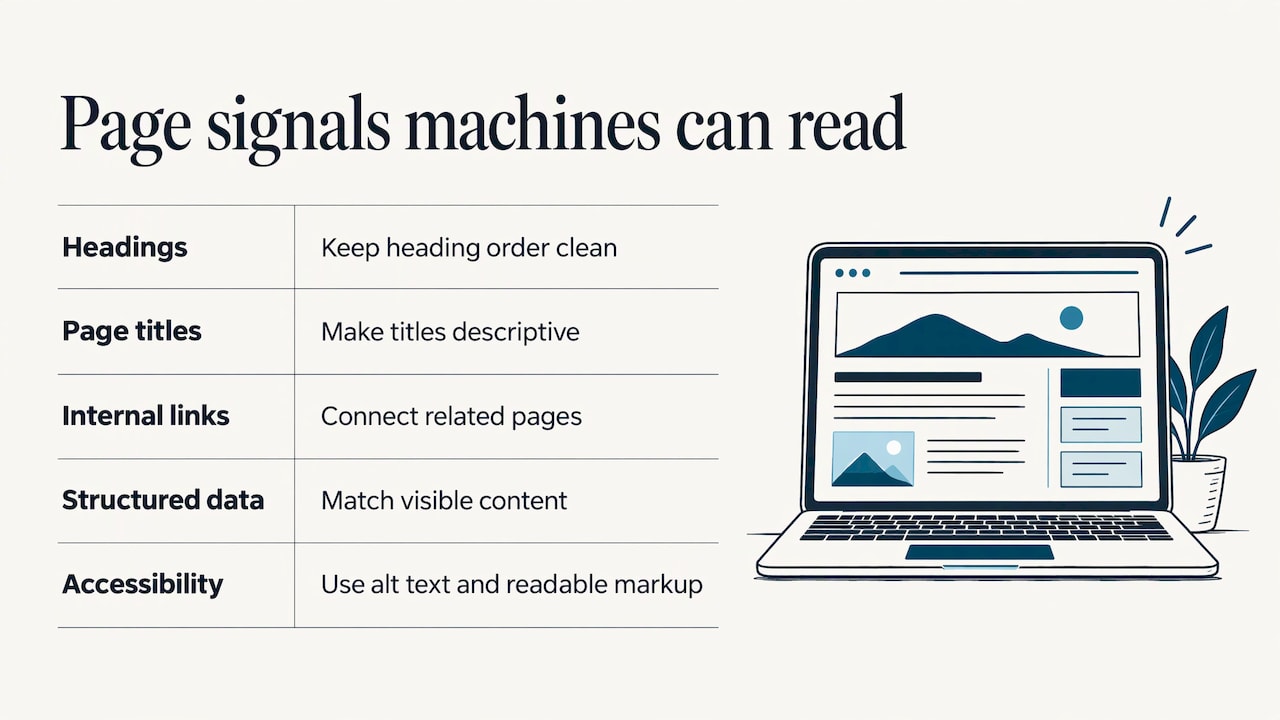
Clean heading order, descriptive page titles, internal links between related pages and structured data (a standard code format that labels a page’s contents, such as business details or frequently asked questions) all help systems understand a page. Structured data should match what is visible on the page. Used well, it clarifies your content. It does not force a citation.
Accessibility helps here too. Proper headings, alt text for images and readable markup serve people using assistive tools and give crawlers a cleaner page. Our web accessibility service covers that side.
What this looks like for Florida lawyers, plumbers and contractors
Local service searches are where AI answers are most useful to customers, and where a specific page beats a generic one.
Business
A question a customer asks an AI tool
The page that can be cited
Personal injury or family law firm
“What should I do after a car accident in Florida?”
A practice-area page that answers the question first, names the attorneys and cites the relevant Florida process
Plumber in Palm Beach County
“Who fixes a burst pipe in Jupiter at night?”
A Jupiter emergency service page with hours, license number and service area
General or roofing contractor
“How much does a roof replacement cost in Palm Beach Gardens?”
A cost page explaining what moves the price, with local project detail
How to measure AI citations without fooling yourself
AI answers vary from one run to the next. The same question can cite different pages an hour apart, so a single screenshot proves nothing. Use a method instead.
Write a fixed list of questions. Choose 25 or more that real customers ask, mixing your services and towns. Keep the list the same from month to month.
Run each question several times per tool. Record whether your business is mentioned, whether your site is linked and which competitors appear.
Watch referral traffic. OpenAI says publishers that allow its search crawler can track ChatGPT referrals in analytics, because links include a utm_source=chatgpt.com parameter. Look for it in Google Analytics.
Check your search reports. Impressions and clicks for the underlying queries show whether the retrieval side is improving.
Keep the results in a spreadsheet and compare quarter to quarter, not day to day.
If you want to build a repeatable framework for tracking AI citations and referral traffic, private AI for business workstations are one option some teams use to run analysis in-house.
Keep expectations honest. Citation is probabilistic and no agency can promise a specific placement. What you can control is access, content quality, local signals and measurement.
Where we fit in
AI citation work touches the site, the content, the listings and the measurement at once. We have built and marketed websites since 1998, and our offer spans custom web design, SEO, local search, content marketing and AI search optimization for ChatGPT, Gemini, Perplexity, Google AI Overviews and Google AI Mode. That means the technical fixes, the page rewrites and the local profile work can be planned together instead of handed between vendors.
For a Florida business that wants to know where it stands, the starting point is our AI search optimization service, with the AI search FAQs answering the common questions.
If you are ready to talk, start at our AI search services page and tell us your trade, your towns and the questions you want to be the answer to.
A 30-day plan to start
Week 1: Confirm indexing, robots.txt and preview settings. Fix anything that blocks access.
Week 2: Pick your five most valuable services. Rewrite each page to answer its main question in the first paragraph, with your license, service area and a local detail.
Week 3: Align your business name, address and phone number across your site and listings. Ask recent customers for reviews.
Week 4: Write your fixed question list, run your first baseline and save the results.
Then repeat the measurement every month, and revisit your pages every quarter.
FAQ
Is AI citation optimization different from SEO?
It builds on SEO. Google’s own guidance says optimizing for its generative features is still SEO, built on indexing, quality content and clear structure. The added focus is on making each page answer a specific question cleanly and on measuring where AI tools mention you.
How long does it take to get cited by ChatGPT or Perplexity?
There is no fixed timeline. A page has to be crawled, retrieved and judged relevant for a question, and answers change between runs. Track your fixed question list monthly and judge progress over a few months rather than a few days.
Do I need to block or allow specific crawlers?
To appear in ChatGPT search, OpenAI says you should not block OAI-SearchBot. For Google, your pages must be indexed and eligible for snippets. Have your developer review robots.txt and meta tags so nothing blocks you by accident.
Does structured data guarantee a citation?
No. Structured data helps systems understand what a page contains, but Google says eligibility for its AI features does not guarantee serving. Use it to describe visible content accurately, alongside strong page content.

 Responsive Web Design
 Content Management Systems
 eCommerce
 Web Maintenance
 Web Hosting
 Web Accessibility


 SEO Search Engine Optimization
 PPC Pay-Per-Click
 SERM Search Reputation
 Local Search
 Social Media
 Mobile Marketing
 Content Marketing