A website redesign costs whatever its scope costs: the number of page types, how much content must be written, what has to be integrated, and how carefully the old site’s search traffic is protected. Published ranges run from a few thousand dollars to six figures because those four decisions swing the price more than any template or hourly rate. The useful question is not “what is the average?” but “which of these decisions apply to my site?” Once you can answer that, quotes from different agencies become comparable. At IWD Marketing we have built custom sites since 1998, and we price each project to its scope rather than from a published rate card.
This guide is for owners of businesses that live on local search and referrals: law firms, plumbers, contractors, and service companies in Palm Beach County and across Florida. It covers what drives the price, what teams forget to budget, how long a project takes, and how to read a proposal.
Iwdesigners
iwdesigners.com
Plan a Redesign Around Your Scope
IWD Marketing builds custom websites and provides SEO, helping businesses plan redesigns around their needs and protect online visibility.
Redesign cost is set by scope: page types, content, integrations (booking, CRM, eCommerce) and search-traffic protection, not by page count alone.
Budget beyond design and development: content, photo and video, SEO work, logo and social graphics, and complex functionality each need their own line.
A “refresh” fits a site whose structure and rankings are sound but whose look, speed or mobile layout has aged. A full redesign fits a site whose structure, platform or messaging no longer serves the business.
Skipping redirects and tracking in a redesign is the most expensive mistake, because it can erase the rankings you already earned.
Compare proposals on deliverables, owners and post-launch support, not on the total alone.
A redesign is not a new coat of paint. It is a rebuild of how visitors find, read and act on your site. Most professional projects move through the same stages, which HubSpot’s B2B website budgeting guide lays out as audience assessment, information architecture (how pages are organized and linked), design, development, and measurement with ongoing optimization.
Each stage carries cost:
Discovery and audit. Reviewing what the current site earns: which pages bring calls, which rank, which are dead weight. Cheap to do, costly to skip.
Structure and content planning. Deciding the page types (home, service pages, location pages, practice areas, case results, contact) and what each must say.
Design. Layouts for desktop, tablet and phone, plus branding adjustments if the logo and colors are dated.
Development. Building the site on a content management system (CMS), the dashboard that lets your staff edit pages without a developer, with forms, tracking and integrations.
Testing and launch. Checking every form, link and device, then switching over with redirects in place.
Post-launch monitoring. Watching rankings, errors and lead flow after the switch.
A low quote usually means one or more of these stages is thin or missing, not that the agency found a cheaper way to do all of them.
The decisions that move the price
Number and type of pages
A ten-page service site and a 200-page site with a blog, location pages and a resource library are different projects. But page type matters more than page count. Fifty near-identical location pages cost less to build than five pages with custom calculators or intake tools.
Custom design versus a template
A customized template shortens design time. A fully custom design costs more because every layout is drawn for your business and your customers. For firms competing on trust, such as law firms, custom work is usually where the difference shows. Our own page on law firm website design covers what that looks like for attorneys.
Content: who writes it
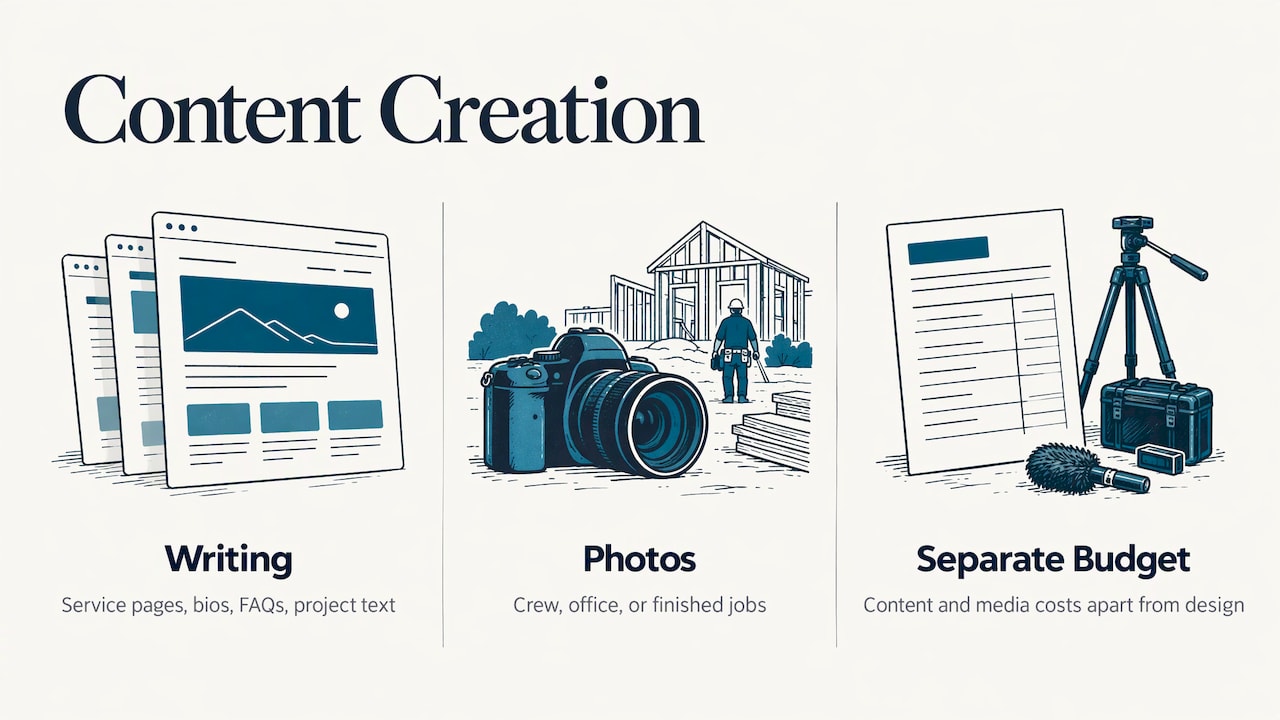
Content is the line item most often left out. If your old pages are thin, someone must write new service descriptions, bios, FAQs and project descriptions, and someone must photograph your crew, office or finished jobs. HubSpot’s guide advises budgeting separately for content creation and for photo, video and infographic assets rather than folding them into the design number. Our content marketing team handles this side so the new site launches with pages worth ranking.
Functionality and integrations
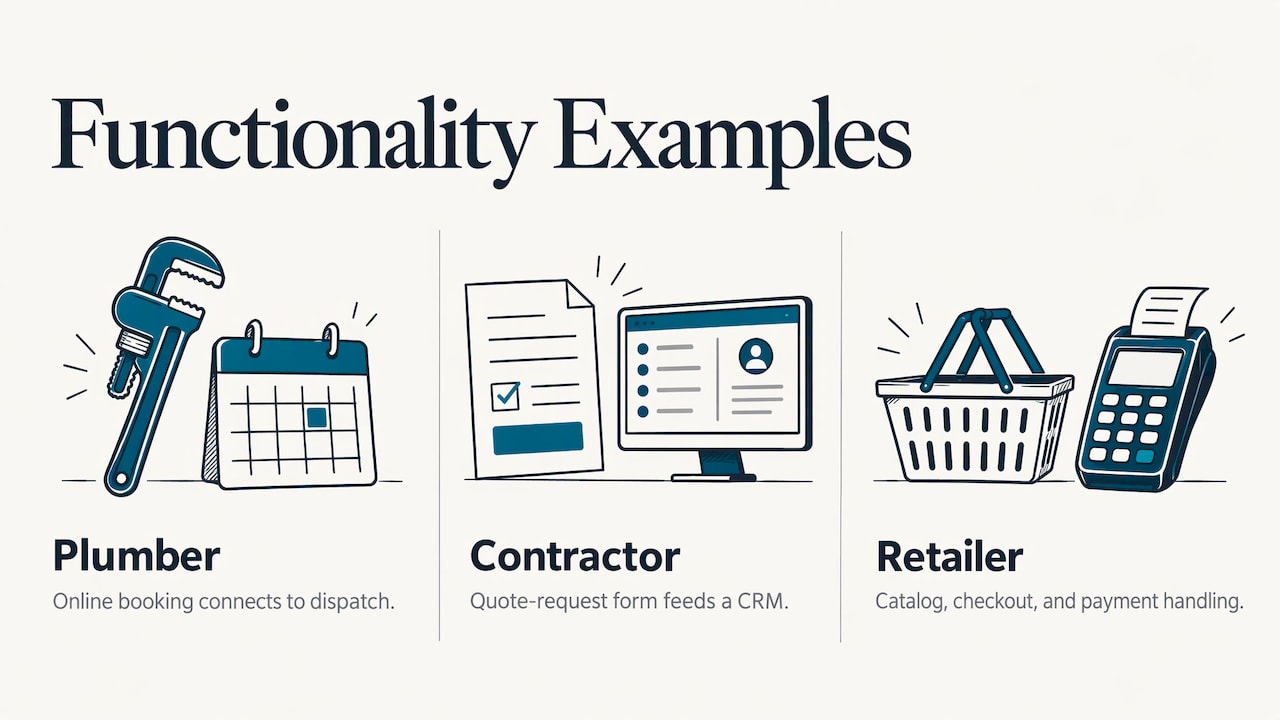
The same guide singles out complex functionality as its own budget item: apps, forums, eCommerce, registration and CRM integration. For a plumber, that might be online booking and a dispatch connection. For a contractor, a quote-request form that feeds a CRM. For a retailer, a full eCommerce build with catalog, checkout and payment handling. Each integration adds design, development and testing time.
Search engine optimization
The guide also lists an SEO assessment as a separate line. Redesigns change URLs, headings, page speed and internal links, and each of those affects rankings. Treating SEO as part of the build, not an add-on afterward, is cheaper than recovering lost traffic.
Accessibility and mobile
A site that works for people using screen readers, keyboards and small screens is a better site for everyone. Building responsive design and accessibility in from the start costs less than retrofitting them after launch.
Costs beyond design and development
The quote for design and development is rarely the whole bill. Plan for these:
That last row matters. HubSpot’s guide cautions that a website project does not replace the broader digital marketing budget. A redesigned site is a better place to send traffic, and it still needs SEO, local search, reviews or ads feeding it.
Refresh or full redesign?
People search for a “refresh” because it sounds cheaper. Sometimes it is the right call, and sometimes it is a smaller version of the same problem.
A refresh is usually enough when:
The site ranks and converts acceptably, but looks dated.
The structure and URLs work, and only the visuals, copy on key pages, photos or calls to action need updating.
The site is already mobile-friendly and runs on a platform your team can still edit.
Speed can be improved by fixing images, scripts and hosting rather than rebuilding.
A full redesign is usually warranted when:
Visitors cannot find your services in two or three clicks.
The platform is outdated, insecure or hard to edit, so every change needs a developer.
The site is not built for phones, or fails basic accessibility checks.
The business has changed: new services, new locations, a new brand.
Rankings and leads have been sliding with no clear fix.
A short audit settles it. Look at which pages bring leads, how the site performs on a phone, and how quickly it loads. Google’s Core Web Vitals give concrete targets: the main content should appear within 2.5 seconds of the page starting to load. If your key pages miss that and the cause is the platform itself, a refresh will not fix it.
How long a redesign takes
Timeline follows scope, and it is a cost factor because a longer project means more hours. A small brochure-style site with ready content moves quickly. A larger site with new content, integrations and a migration takes longer, and the usual cause of delay is content arriving late from the client, not design or code.
What you can control:
Name one decision-maker. Feedback from five people on every round doubles the revision count.
Gather content early. Bios, project photos, service descriptions and testimonials should be in hand before design is finished.
Agree on what launch means. Decide up front which features ship at launch and which come in a second phase.
A redesign checklist that protects what you have
This is where most of the avoidable cost sits. Before work starts and before launch, confirm the following.
Before design begins
Export current rankings, top landing pages and lead sources, so you can measure the result.
List every URL on the old site and mark which ones earn traffic or links.
Decide the new page structure and map each old URL to its new home.
Gather content, photos and testimonials.
Set goals: calls, form fills, quote requests, booked consultations.
Before launch
Test every form, phone link and checkout step on real phones and in the main browsers.
Check page speed and usability on mobile.
Install analytics and call tracking, and confirm they record.
Set up redirects from old URLs to new ones. Google explains that 301 and 308 redirects signal that a page has permanently moved, which is how visitors and Google reach the right page after a change.
Confirm titles, headings and meta descriptions carried over for pages that rank.
After launch
Watch for crawl errors, broken links and form failures closely in the first days, and then weekly for a while.
Compare traffic and leads against the baseline you exported.
Update your Google Business Profile and directory listings so the URLs match.
A redesign that skips the redirect map is the costliest shortcut. Every old URL that now returns an error is a page that once earned visits and now earns none.
Best practices for a local-service redesign
For businesses working one county or one state at a time, a few choices pay off consistently:
Make the phone number and quote button impossible to miss on mobile. A plumber’s customer with a leaking pipe is not browsing.
Give each service and each city its own page, with content specific to Jupiter, Boca Raton, Palm Beach Gardens or wherever you work, not copied text with the town name swapped.
Show proof: licenses, project photos, reviews, case results where your profession’s rules allow.
Plan for AI search. More people now get answers from Google AI Overviews, ChatGPT and similar tools. Clear structure, specific service content and consistent business details help those systems understand who you are. Our AI search services are built for that.
Keep editing simple. A CMS your staff can use means updates happen the week they are needed.
How to compare redesign proposals
Two quotes with a $10,000 gap are rarely for the same project. Put them side by side on a scorecard:
Question
What a clear proposal says
Deliverables
Page types, templates, number of design rounds
Content
Who writes it, who supplies photos
SEO
Audit, redirect map, on-page setup named as tasks
Integrations
Each form, CRM, booking or payment tool listed
Testing
Devices and browsers, speed, forms
Ownership
A named project lead and who handles launch problems
After launch
Monitoring period, support, maintenance and hosting terms
Ownership of assets
Who owns the design files, content and domain
The point of a scorecard is to judge measurable outputs and accountable owners, not a single package price. A proposal that names who owns SEO, analytics and testing is a proposal you can hold to account.
What working with IWD looks like
If your site is aging and you want one team to handle the whole job, that is what we do. IWD Marketing has been building websites since 1998 and is recognized as a top agency in South Florida. We design custom, responsive sites on content management systems, and we cover the work around the build too: SEO, local search, hosting, maintenance and AI search optimization. That means the redesign, the redirects, the tracking and the marketing that follows are planned together instead of passed between vendors.
We price each project to its scope, so the quickest way to a real number is to tell us what your site does today and what you want it to do. Start with IWD Marketing and we will map your pages, content and integrations into a proposal you can check against the scorecard above.
Frequently asked questions
How much should a small business budget for a website redesign?
It depends on page types, content and integrations more than on the number of pages. A simple service site with existing content sits at the low end. A site with new copywriting, photography, booking or eCommerce sits well above it. Ask for a scoped proposal and budget separately for content, SEO and ongoing hosting and maintenance.
Is a website refresh cheaper than a redesign?
Yes, because a refresh keeps your structure and URLs and updates design, key content and speed. It fits a site that still ranks and converts but looks dated. If the platform or navigation is the problem, a full redesign gets better results for the money.
Will a redesign hurt my Google rankings?
It can if URLs change without redirects, or if ranking pages lose their content. Mapping every old URL to a new one with permanent redirects, and keeping the titles and headings of pages that rank, protects the traffic you have earned.
What should I have ready before I ask for quotes?
Your current site address, a list of the pages that bring in calls, your goals, any integrations you need, and your existing photos and logo files. With those, a proposal can be specific about scope instead of a broad estimate.

 Responsive Web Design
 Content Management Systems
 eCommerce
 Web Maintenance
 Web Hosting
 Web Accessibility


 SEO Search Engine Optimization
 PPC Pay-Per-Click
 SERM Search Reputation
 Local Search
 Social Media
 Mobile Marketing
 Content Marketing