Marketing performance tracking means tying every marketing activity to a business result you can count: calls, form fills, booked jobs, signed cases, revenue. You do it by choosing one business goal, picking a few KPIs that prove progress toward it, wiring up tracking for each channel, and reviewing the numbers on a fixed schedule. Since 1998, we at IWD Marketing have built websites and run SEO, PPC and local search campaigns around results a business owner can measure, and this guide lays out the routine we would hand to any owner, from a Palm Beach County plumber to a Florida law firm.
Iwdesigners
iwdesigners.com
Make Marketing Results Measurable
IWD Marketing connects custom web design, SEO, and digital marketing with measurable business outcomes, backed by experience since 1998.
What marketing performance tracking actually covers
One analytics firm describes marketing analytics as measuring, analyzing and acting on data about marketing performance to understand what drives business growth. The “acting” part is the one most businesses skip.
Two terms are worth separating. Measurement is the whole picture: engagement, reach, conversion rates, channel effectiveness and business outcomes. Attribution is the subset that connects marketing activity to leads, pipeline and revenue, as Humans of Martech explains. Mixing the two up leads teams to over-trust attribution or to throw it out entirely, when what they needed was a different method for the question they were asking.
Most businesses are behind on this. According to a 2024 MIT Sloan Management Review article, citing the Clevertouch State of Martech 2024 report, just 40% of companies actively track metrics linking marketing to revenue, and often only ad hoc. Getting a simple, consistent system running puts you ahead of most.
Step 1: Pick the business goal first
The same MIT Sloan piece says the first essential is aligning metrics with strategy, and warns that failing to do so can be catastrophic, because whatever leaders endorse as a metric signals what staff should prioritize. A plumber who celebrates website traffic will get traffic. A plumber who celebrates booked service calls will get calls.
A workable goal is specific and time-bound. HubSpot’s KPI guide suggests starting with one business goal and testing each candidate KPI against SMART criteria: specific, measurable, achievable, relevant and time-bound. Examples for the businesses we work with:
Plumber: raise booked service calls from organic search and Google Ads by a set number per month over the next quarter.
Contractor: increase qualified estimate requests from the website in a defined service area.
Law firm: increase consultation requests for one practice area.
Then write down what a “qualified” lead is. A call from a job seeker or a vendor is not a lead. This one definition prevents most arguments about whether marketing is working.
Step 2: Map KPIs to the customer journey
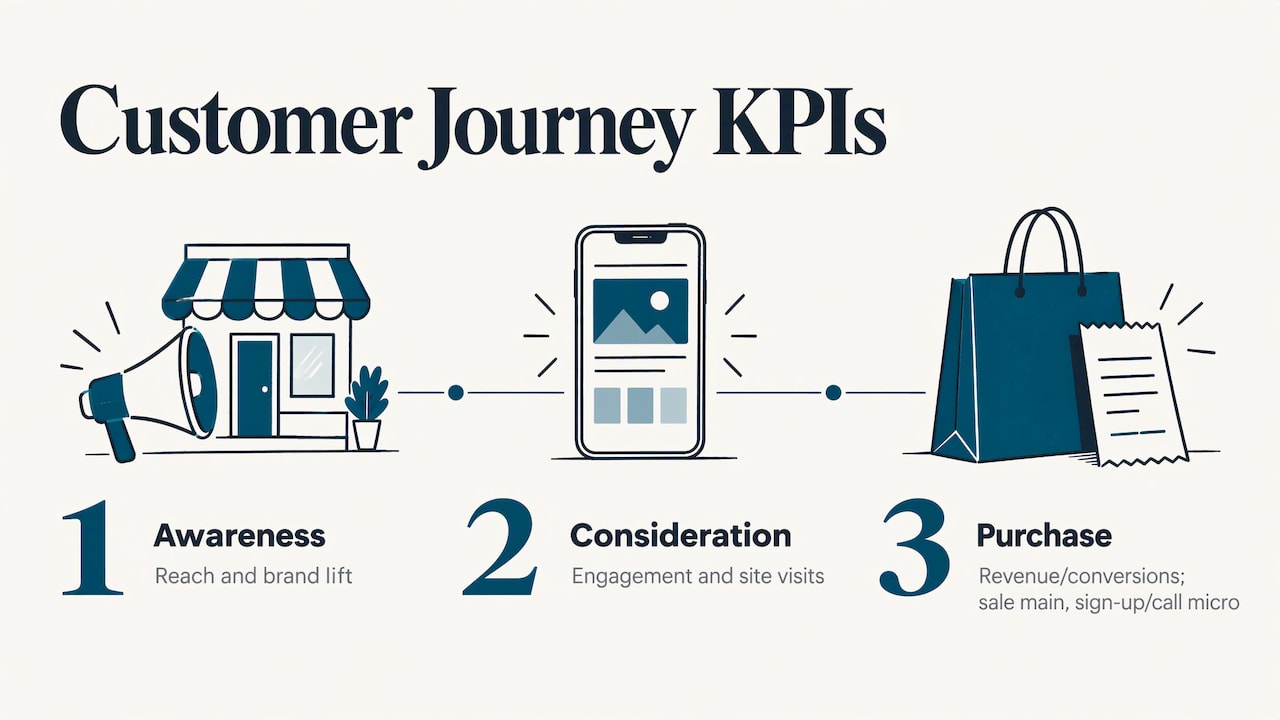
A KPI (key performance indicator) is a number you watch because it tells you whether the goal is being met. LiveRamp’s measurement plan guide maps them to journey stages: reach and brand lift for awareness, engagement and site visits for consideration, and conversions and revenue for purchase. It also separates primary conversions (a sale) from micro-conversions (a sign-up or a click to call), so you can see where prospects stall.
Keep the list short. HubSpot recommends a handful of KPIs that mix leading indicators (early signals such as qualified clicks) and lagging ones (results such as revenue). BCG’s 2025 study found that leaders pick one or two “north star” KPIs, with every other metric laddering up to them, and that half of leading marketers include both brand and performance KPIs in their framework.
For a local service business, a sensible north star is cost per qualified lead or booked job. Everything else supports it.
Calls and direction requests from your business profile
Review count and rating, local rankings
Social media
UTM-tagged visits and conversions
Reach, engagement rate, clicks
Email
Revenue or leads per send
Click rate, conversion rate, unsubscribe rate
The channel lists draw on Supermetrics’ 2026 guide and the Marketers.com guide above. ROAS is return on ad spend: revenue divided by what you spent on ads. Quality Score is Google’s 1 to 10 rating built from expected click-through rate, ad relevance and landing page experience, as Ahrefs describes it.
Two cautions apply. First, email open rate has become unreliable: Supermetrics notes that Apple’s Mail Privacy Protection made it less trustworthy, so lean on clicks and conversions. Second, for social, Salesforce’s analytics guide contrasts engagement rate with raw follower counts, and conversion rate by traffic source with total pageviews. Choose the actionable version each time.
What this looks like for Florida lawyers, plumbers and contractors
Local service businesses win or lose on a short list of actions. Google lists them among the things Google Ads conversion tracking can count: quote requests, phone calls, sign-ups and other button clicks. For you, that translates to:
Phone calls. For a plumber with an emergency service, the call is the sale. Track calls from the website, from ads and from your Google Business Profile separately.
Quote and estimate forms. For a contractor in Palm Beach County, every form should record the page and source it came from.
Consultation requests. For a law firm, track by practice area, since a personal injury lead and an estate planning lead have very different values.
Service-area signals. Check that leads come from the towns you actually serve, such as Jupiter, Palm Beach Gardens, Stuart or Boca Raton, rather than anywhere in the state.
Then close the loop. Tracking tells you a call arrived. Only your own records tell you whether it became a job. A weekly note of “calls that turned into booked work” next to the call count is the single most useful habit for a small business.
Step 4: Set up the tracking itself
Good tracking is mostly plumbing, and errors here corrupt everything after it.
Define conversions. In Google Analytics 4, important actions are called key events; when they are imported into Google Ads they are called conversions. Mark form submissions, click-to-call taps and booking confirmations.
Tag your links. Use UTM parameters (short tags added to a URL) on social posts, emails and any link you control so visits are credited to the right source.
Track calls. Decide how you will tell website calls, ad calls and profile calls apart, and test it by placing a call yourself.
Document the data. MarketingProfs’ measurement playbook guidance says to document the measurement process and define the data sets and sources behind each metric. A one-page sheet naming each KPI, where it comes from and who owns it is enough.
Keep the site healthy. Tracking breaks when pages are rebuilt, forms change or plugins update. Our website maintenance and responsive web design work keeps the pages that carry your forms and call buttons working on every device.
If your site is slow to turn visits into calls, our guide to conversion rate optimization explains what that work involves.
Step 5: Choose how to credit the results
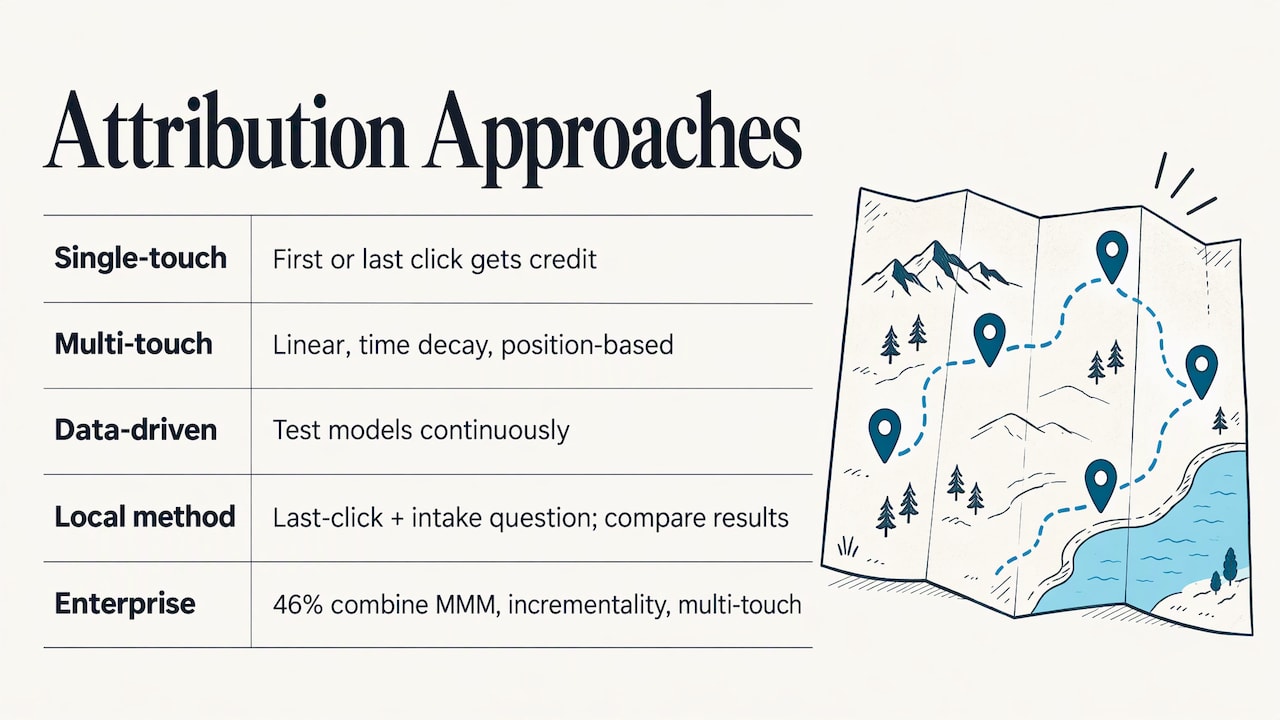
When a customer sees a Google ad, later searches your name and then calls, which channel gets the credit? That is attribution. The IAB’s November 2024 playbook says models should match business goals and the complexity of the customer journey. Options range from single-touch (all credit to the first or last click) to multi-touch (linear, time decay, position-based) and data-driven models, and they should be tested continuously.
For most local businesses, a simple approach works: use last-click numbers inside each platform, add a “how did you hear about us?” question to every form and phone intake, and compare the two. Where they disagree, you have found something to investigate.
Larger budgets call for more. BCG found that 46% of marketers combine marketing mix modeling (statistical analysis of spend against sales, which per Humans of Martech needs two or more years of data), incrementality testing for causal insight, and multi-touch attribution for daily optimization. That is enterprise territory; the principle that carries down is to use more than one lens.
Step 6: Read the data and act on it
Numbers only matter if they change what you do. Forbes Agency Council suggests four layers of analysis: descriptive (what happened), diagnostic (why), predictive (what could happen next) and prescriptive (what to do about it). It also recommends weighing outside factors such as campaign timing, audience shifts and competitors’ strategies.
A worked example. Your Google Ads cost per call rises 30% in a month:
What happened: cost per call went up while clicks stayed flat.
Why: the search terms report shows spend going to broad terms outside your service area, and the landing page conversion rate dipped after a site update.
What next: tighten location and keyword targeting and repair the page.
Action: make the changes and check the same KPI in the following weeks.
Match the time window to the channel. Marketers.com advises judging slow channels like SEO and organic social on quarterly trends, not month-to-month swings, and holding each channel owner accountable for one primary money metric so budget shifts toward the healthier channel.
Step 7: Build a report and a rhythm
A useful report is short. Supermetrics’ reporting guide says to include a summary page, a scorecard number before any breakdown, KPIs matched to the decision, a comparison period (last month or the same month last year) and a recommended next action. BCG’s guidance for CMOs and CFOs points to a measurement architecture of typically five to ten metrics, which is plenty for any small business.
Weekly: a light check of spend pacing, cost per lead and lead volume.
Monthly: the full report against your goal and last month.
Quarterly: a strategic review of which channels earn more budget and which KPIs need changing.
The same Fairview guide publishes benchmark ranges, such as 1.5 to 3.5% click-through rate for non-branded Google Ads search. Treat benchmarks as a rough starting point and compare against your own history first, because your trade, town and season differ from any average.
Where we fit in
Tracking is only as useful as the campaigns it measures. We run SEO, Google Ads and PPC management, local search marketing and AI search optimization for businesses across Boca Raton, Jupiter, Palm Beach Gardens, Stuart and the rest of South Florida, with a focus on measurable outcomes. If you want those numbers tied to the calls and cases your business depends on, start with the IWD Marketing home page and tell us your goal.
If customers increasingly find you through answers from ChatGPT, Gemini, Perplexity or Google’s AI Overviews, that visibility belongs in your reporting too, and our Google AI Overviews optimization page explains how we approach it.
FAQ
How do I measure marketing performance with a small budget?
Pick one goal, such as booked jobs, and track two or three numbers: leads by source, cost per lead and the share of leads that became customers. Mark calls and form submissions as conversions in your analytics, tag your links, and review monthly. A simple sheet beats an elaborate dashboard nobody opens.
Which marketing analytics metrics matter most?
The ones tied to money: conversions from non-brand organic search, cost per acquisition or ROAS for paid ads, and revenue or leads per email send. Reach, impressions and rankings are supporting metrics that explain why the money metric moved.
How often should I review marketing performance?
Check spend and lead volume weekly, run a full report monthly and hold a strategic review quarterly. SEO and organic social move slowly, so judge them on quarterly trends rather than single months.
What is the difference between measurement and attribution?
Measurement covers everything: engagement, reach, conversion rates and business outcomes. Attribution is the narrower task of crediting leads and revenue to specific marketing activity. Use attribution to answer “which channel earned this lead?” and broader measurement to answer “is marketing growing the business?”
Do vanity metrics ever matter?
They are fine as context, but never as the goal. Followers, pageviews and email subscribers do not tell you whether a decision was right. Pair them with a conversion or revenue figure from the same channel.

 Responsive Web Design
 Content Management Systems
 eCommerce
 Web Maintenance
 Web Hosting
 Web Accessibility


 SEO Search Engine Optimization
 PPC Pay-Per-Click
 SERM Search Reputation
 Local Search
 Social Media
 Mobile Marketing
 Content Marketing