Conversion rate optimization (CRO) services are paid help that turns more of your existing website visitors into calls, form fills, bookings or sales. For a Florida law firm, a Palm Beach County plumber or a contractor, the best results usually come when the same team controls the website, the traffic sources and the measurement. A page that is tested in isolation, on traffic that was never qualified, rarely moves revenue. We build and market websites for South Florida businesses, and we have done so since 1998, so this guide is written from the site-and-marketing side of the problem.
Iwdesigners
Make Your Website Work Harder
IWD Marketing builds responsive websites and digital marketing solutions for South Florida businesses seeking stronger visibility and engagement.
CRO means improving the share of visitors who take a valuable action, such as a call, a quote request or a purchase, without buying more traffic.
Services range from a one-time audit to an ongoing testing program. Price depends mainly on traffic volume, how many tests run and how much work the provider does for you.
Real testing needs enough visitors to reach a trustworthy result. Low-traffic local sites often gain more from a fast, clear, mobile-first rebuild and better-targeted traffic than from split tests.
Treat guaranteed percentage lifts as a warning sign. Advertising claims must be truthful and backed up.
Measure results in booked jobs, signed cases and revenue, not only in the conversion rate itself.
What conversion rate optimization services actually are
Your conversion rate is the number of visitors who complete a goal divided by the total number of visitors. If 1,000 people visit your site in a month and 25 of them request a quote, your conversion rate is 2.5%. A “conversion” is whatever you define as valuable: a phone call from the site, a contact form, a downloaded guide, a checkout.
CRO services are the work of raising that percentage. The work usually covers four jobs:
Measuring. Setting up analytics so every call, form and sale is tracked back to its source.
Diagnosing. Reviewing how visitors move through the site, where they leave and what stops them from acting.
Changing. Rewriting headlines, simplifying forms, reorganizing pages, improving speed and mobile layout, making the next step obvious.
Checking. Comparing results before and after, or running controlled tests where traffic allows.
The ranking agencies in this field tend to stress A/B testing, heat maps and behavior analysis. Those are real tools. But for most local service businesses, the largest conversion gains come from fundamentals: a page that loads quickly on a phone, a phone number that can be tapped, a clear offer, and proof that you are the right company.
The main types of CRO engagements
Providers package the work in a handful of ways. Knowing the type tells you what you are really buying.
Type
What you get
Fits best
One-time audit
A written review of your site and tracking with a prioritized list of fixes
Owners who want a roadmap and have someone to carry it out
Testing program
A steady stream of controlled experiments run against an agreed roadmap
Sites with high, steady traffic
Full-service management
The provider diagnoses, designs, builds, tests and reports
Owners who want the work off their plate
Training or consulting
An expert coaches your in-house team on process
Companies with a marketing staff
Hybrid
Some mix of the above, often an audit followed by a lighter monthly program
Businesses moving from fixes to ongoing improvement
For a plumber or a contractor without a marketing department, the realistic choices are the audit-plus-implementation route and full-service management. A training model assumes someone on your side has hours to spare.
Why traffic volume decides what kind of CRO works
A/B testing splits visitors between two versions of a page and compares the outcomes. The catch is statistics: a difference only counts if enough people saw each version for it to be unlikely that luck produced it. Practitioners commonly aim for 95% statistical confidence and calculate the needed sample size before a test starts. They also run each test for at least one full business cycle, typically two weeks, so weekday and weekend behavior both show up.
Here is a worked example. Say your contractor site gets 800 visitors a month and converts 3% of them, which is 24 leads. To confirm that a new page lifts that to 4%, you would need several thousand visitors on each version. At 800 a month, that test could run for many months, and by then the season, your ad spend and your rankings will have shifted. The result tells you little.
That is why a Palm Beach County plumber is often better served by one decisive redesign, informed by the best available evidence, than by a testing program built for an online retailer with 50,000 monthly visitors. Testing earns its fee when traffic is large enough to produce answers within weeks, not seasons.
If your traffic is on the low side, the options that still work are:
Fix what is plainly broken: slow pages, hard-to-read mobile layouts, missing calls to action.
Compare before-and-after periods, while accounting for seasonality and changes in ad spend.
Grow qualified traffic through search and paid campaigns so testing becomes viable later.
What a good engagement looks like, step by step
Whatever the package, a sound engagement follows a recognizable sequence. Here is what each step takes and where it commonly goes wrong.
Step 1: Set up tracking you trust
Before anything is changed, you need to know how many calls, forms and purchases the site produces today. The common failure is counting the wrong thing: form submissions that are spam, calls that are wrong numbers, or a “thank you” page that fires twice. Insist on tracking phone calls as well as forms, since service businesses often win more work by phone than by form.
Step 2: Audit the site and the traffic together
A conversion problem is sometimes a traffic problem. If your pay-per-click ads bring in people searching for a service you do not offer, no page design will rescue the rate. A useful audit looks at the pages, the keywords and ads that send visitors there, and the device they use. We run this kind of review across SEO and pay-per-click management because the two sides feed each other.
Step 3: Prioritize by revenue, not by opinion
Audits produce long lists. The skill is ranking them by likely revenue impact and effort. A tap-to-call button on a service page will usually outrank a color change on a footer. The common failure here is chasing whatever the loudest stakeholder dislikes about the current design.
Step 4: Make the changes on a site you can actually change
This step is where many CRO programs stall. A provider that only advises depends on your web developer, your hosting setup and your content system to carry out each recommendation. When one team builds the pages, manages the content management system and handles the hosting, changes ship without a handoff.
Step 5: Check results over a fair window
One good week proves nothing. Compare like with like, such as the same weeks across seasons, and judge by leads that became customers. A common estimate for a first round of controlled tests is several weeks, and for meaningful results a few months. Plan on that timeline rather than on a quick win.
The pages and elements that move conversions on local service sites
For lawyers, plumbers and contractors, most conversions come from a few places. Start your review here.
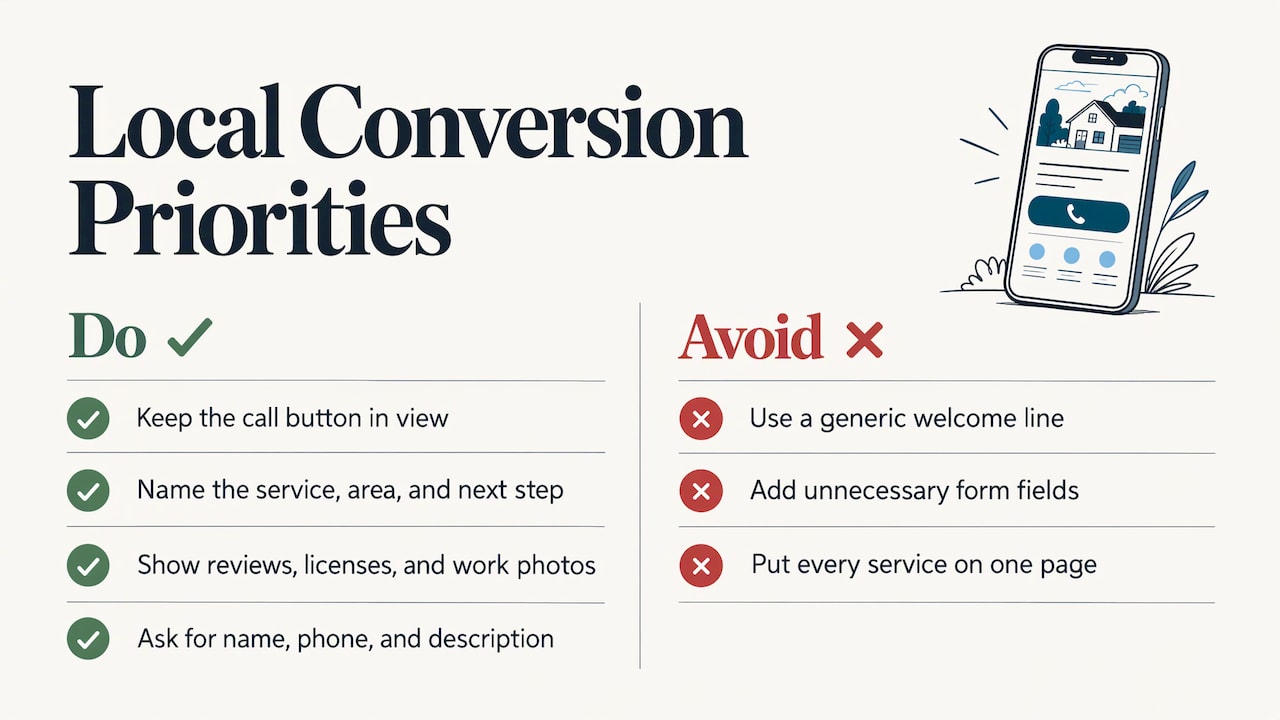
The mobile experience. Someone with a burst pipe is searching on a phone. The call button should sit in view, pages should load fast and forms should ask for as little as possible. Our responsive web design work starts from the phone screen for this reason.
The headline and the first screen. Visitors decide in seconds whether they are in the right place. Name the service, the area you serve and the next step. “Palm Beach Gardens emergency plumbing, call now” beats a generic welcome line.
Proof. Reviews, licenses, years in business and photos of real work reduce the risk a visitor feels. Reputation matters as much as design, which is why search reputation management belongs in the same conversation as page design.
Forms. Every extra field costs responses. Ask for name, phone and a short description. You can collect the rest on the call.
Accessibility. A site that people with disabilities cannot use turns away visitors and can create legal exposure. Web accessibility work often improves clarity for everyone, which helps conversion as well.
Page-per-service structure. A single page that lists every service converts worse than separate pages that match what a person searched for. This also helps search rankings, so one change serves two goals.
A note for Florida lawyers
Lawyer advertising in Florida is regulated by The Florida Bar, and your website counts as advertising. Testimonials, claims about results and promises of outcomes need review against the Bar’s current rules before they go live. Treat the Bar’s rules as a design constraint from the first draft, and have your own ethics counsel or the Bar’s advertising staff confirm wording on any page that makes claims about results.
A note for online stores
If you sell products online, checkout friction is the first place to look: forced account creation, surprise shipping costs and slow payment pages. Our eCommerce builds treat the path from product page to payment as the core of the site.
How CRO services are priced
Providers generally charge in one of three ways, and each fits a different situation.
Project fee. A set price for an audit or a defined redesign. It suits owners who want a clear scope and an end date.
Monthly retainer. A recurring fee for ongoing analysis, changes and reporting. It suits sites with enough traffic to keep testing.
Hourly rate. Typically offered by freelancers and consultants for advice or small tasks. Cost is hard to predict, because it depends on how many hours the work takes.
What moves the price within each model:
Traffic volume. More visitors mean faster tests and more of them, so more work.
Testing speed. Running a few experiments a month costs less than running a dozen.
Complexity of the business. Multiple locations, many services or an online store with a large catalog all add scope.
State of your tracking. If analytics are broken or missing, setup comes first.
Advice versus execution. Strategy alone costs less than strategy plus design, development and copywriting.
We do not publish a fixed price for conversion-focused work, because the scope depends on the site and the traffic behind it. The fair way to compare providers is to ask each for a written scope covering what will be measured, how often you will get reports and who makes the changes. Two quotes with different prices often describe different amounts of work.
How to tell whether CRO is worth the money
Do a quick calculation before you shop. Take your monthly visitors, your conversion rate and the average value of a customer. Then ask what a one-point improvement would be worth.
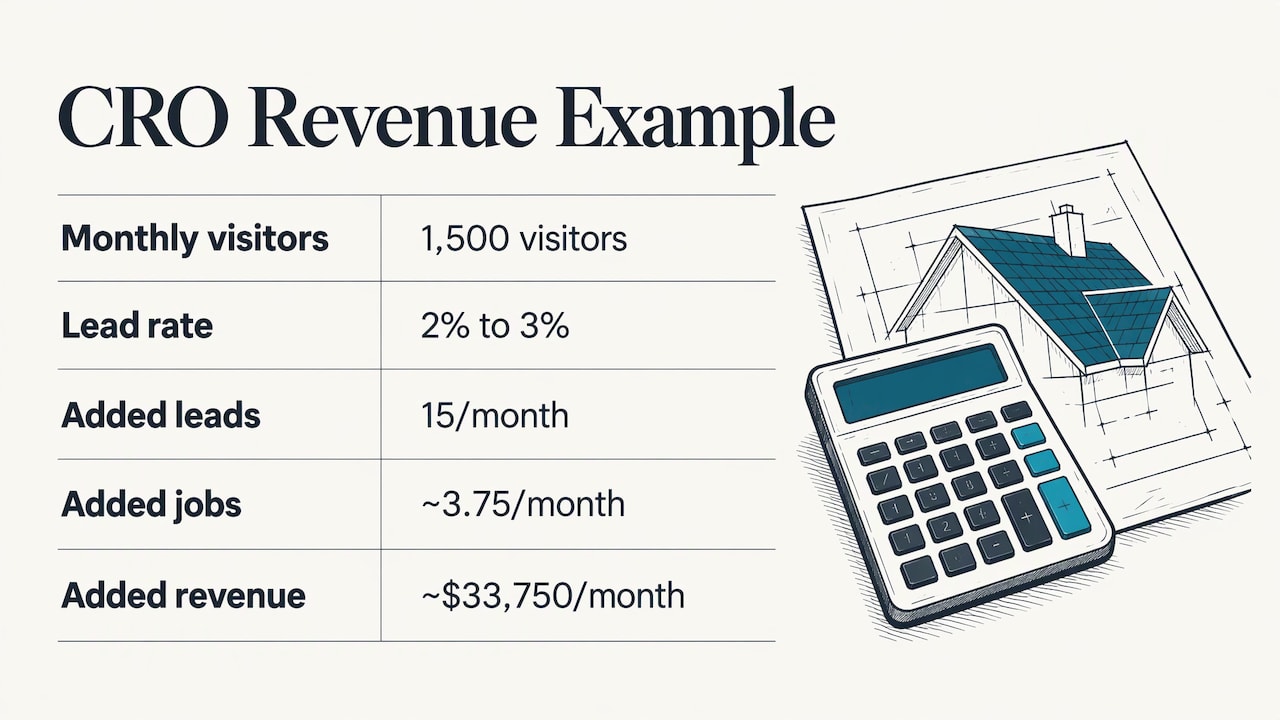
Suppose a roofing contractor has 1,500 monthly visitors, a 2% lead rate and closes one lead in four, with an average job worth $9,000. That is 30 leads, about 7.5 jobs, around $67,500 a month. Lifting the lead rate from 2% to 3% adds 15 leads, roughly 3.75 more jobs, about $33,750 in monthly revenue. Even a modest improvement dwarfs most service fees at those job values. The same arithmetic can also show you when CRO is not worth it: a business with 100 visitors a month and a low-value sale has little to optimize.
The exercise also keeps you honest about the real prize. A higher conversion rate that brings in unqualified leads wastes your crew’s time. Count the leads that turn into paid work.
Red flags when choosing a provider
Here are the points that separate careful practitioners from salespeople:
Guaranteed percentage lifts. Nobody controls how visitors behave. The Federal Trade Commission’s advertising and marketing guidance for businesses says claims must be truthful and supported by evidence, and a guaranteed result is hard to support.
A detailed proposal before anyone has seen your analytics. Specific recommendations require specific data.
Case studies without baselines. Good examples show the starting conversion rate, the traffic, how long the test ran and how confident the result was.
Reports that show only wins. Tests that fail teach as much as those that succeed, and an honest provider shares both.
Vague answers about method. Ask how they decide what to test first, how they calculate sample sizes and how long tests run.
Good advice about hiring applies to any creator or small business hunting for an audience, and ideas for strengthening audience connection show how trust and repeat engagement support the same goal as conversion work.
Where AI search fits into conversion work
More buyers now start with an AI answer instead of a list of links. That changes the front end of the funnel: fewer, better-informed visitors may arrive, and they arrive expecting your page to confirm what they already read. Pages that state who you serve, what you do and what happens next in plain language serve both people and the systems summarizing your site. We offer AI search optimization covering Google AI Overviews, Google AI Mode, ChatGPT and Gemini, so visibility and conversion are planned together.
Why one team for site, traffic and results
Conversion rate is the product of three things: who arrives, what they see and how easily they can act. When those belong to three vendors, each one can point at the others when results stall. The ad agency blames the landing page, the developer blames the ad targeting and no one owns the number that matters, which is booked work.
IWD Marketing has worked on websites and online marketing since 1998, builds sites with responsive design and content management systems, and runs SEO, pay-per-click and local search for businesses in Boca Raton, Jupiter, Palm Beach Gardens, Stuart and the surrounding area. Our approach is built around measurable outcomes, so the question we start with is how many more of your visitors can become customers, not how the site looks.
Work with IWD Marketing
If your site gets traffic but not enough calls or sales, we can review the pages, the tracking and the campaigns that feed them, and then make the changes on the site ourselves. Start with our web design and development services, or tell us about your goals through the IWD Marketing home page.
We work with lawyers, plumbers, contractors and other local businesses across Palm Beach County and South Florida, as well as organizations that need custom sites and digital marketing. Our FAQ page answers common questions about how we work.
FAQ
What do conversion rate optimization services include?
They typically include analytics setup, a review of how visitors use your site, a ranked list of improvements, the changes themselves and reporting. Some providers add controlled A/B tests, which need enough traffic to give reliable answers. Packages range from a one-time audit to a full monthly program.
How much do conversion rate optimization services cost?
Prices depend on whether you pay a project fee, a monthly retainer or an hourly rate. The main drivers are your traffic, how many tests run, the complexity of your business and whether the provider also does the design and development. Ask for a written scope so you can compare quotes on equal terms.
Is conversion rate optimization worth it for a small local business?
It can be, when the value of a customer is high. A few extra jobs a month from the same traffic can outweigh the cost. Low-traffic sites usually gain more from fixing speed, mobile layout and calls to action than from split testing.
How long does it take to see results?
Fixing obvious problems can show effects within weeks. Controlled tests need several weeks each to reach a reliable result, and a program usually needs a few months before the pattern is clear. Judge results over a full season where your business has one.

 Responsive Web Design
 Content Management Systems
 eCommerce
 Web Maintenance
 Web Hosting
 Web Accessibility


 SEO Search Engine Optimization
 PPC Pay-Per-Click
 SERM Search Reputation
 Local Search
 Social Media
 Mobile Marketing
 Content Marketing