Google Ads management typically costs a flat monthly fee, a percentage of your ad spend, or a mix of both, and it is always paid on top of the money you spend with Google. A published agency pricing guide puts flat monthly fees between $200 and $4,000, with most plans at $500 to $2,000. Where you land depends on your ad spend, how many campaigns you run, and how much work sits around the ads, such as landing pages and call tracking. For a Palm Beach County plumber, contractor or Florida law firm, the real question is not the fee alone. It is what each dollar of fee plus spend brings back in calls and signed jobs.
We are IWD Marketing, a Boca Raton agency that has built websites and run digital marketing since 1998. Our Google Ads pay-per-click management is quoted per business, so this guide gives you the numbers and the logic to judge any quote, ours included.
Iwdesigners
Make your Google Ads budget work harder
IWD Marketing manages Google Ads campaigns and offers custom web development, SEO, and AI-driven optimization for businesses seeking online visibility.
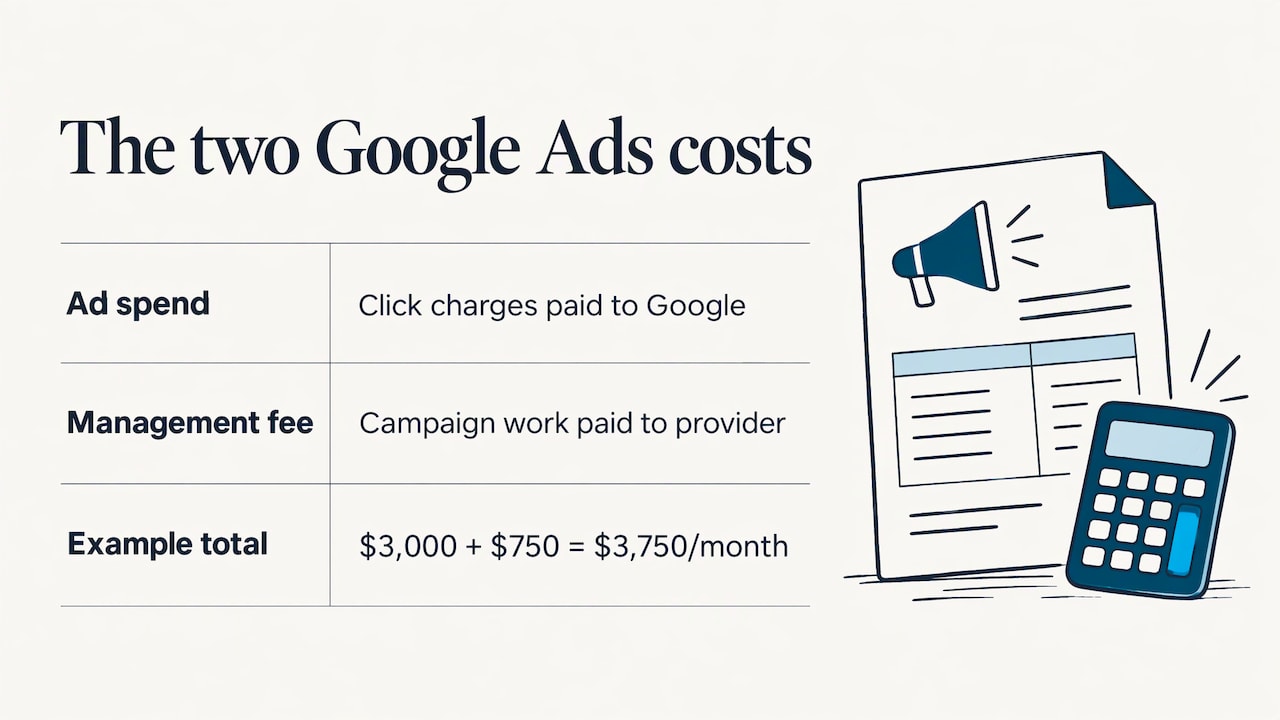
Two separate bills: the management fee goes to whoever runs your account, and the ad spend goes to Google when people click.
Published agency guides put flat management fees between $200 and $4,000 a month, with most between $500 and $2,000. Percentage models commonly use around 10% to 20% of spend.
Google will not charge you more than 30.4 times your average daily budget in a month, so you can set a hard ceiling on spend.
A low fee on a tiny budget can still work, but the ad budget has to be large enough to buy a useful number of clicks in your market.
Judge a quote by what it covers (setup, landing pages, tracking, reporting) and by the lead numbers it is meant to produce, not by the fee alone.
Every Google Ads program has two parts, and mixing them up is the most common source of confusion.
Ad spend is what Google charges when someone clicks your ad. You control it with a daily budget and bids. It goes to Google, not to your agency.
Management fee is what you pay a person or a team to build the campaigns, write the ads, choose keywords, adjust bids, exclude wasteful searches and report results. It goes to the provider.
So a business spending $3,000 a month on clicks with a $750 management fee has a total monthly cost of $3,750. When you compare quotes, always put both numbers side by side. A “cheap” fee attached to a program that wastes a third of the click budget is not cheap.
How agencies price Google Ads management
There are four models you will see in the US. Each suits a different kind of business.
Flat fees are easy to budget for. They fit a local service business with a steady budget, such as a plumber running one or two campaigns in a single county.
Percentage of ad spend
The fee is a share of what you spend with Google. The same guide gives 20% of monthly spend as an example. On $3,000 of spend, 20% is $600. On $10,000 it is $2,000.
This model scales with the size of the account, which makes sense when more spend means more campaigns to manage. Ask whether the percentage drops as spend grows, and whether it applies to the budget you set or to what Google actually charged.
Base fee plus percentage
A combined example from that guide is $1,000 plus 10% of spend. At $5,000 of spend, that is $1,500 in total. This is common for larger or more complex accounts, where a minimum covers the fixed work of strategy and reporting.
Hourly or project pricing
Hourly rates suit audits, training or a one-time account cleanup. Project pricing suits a new account build. Neither replaces ongoing management, because Google Ads performance moves with bids, competitors, seasons and search behavior. An account left alone drifts.
Quick comparison
Model
How the fee is set
Best fit
What to watch
Flat monthly fee
Fixed amount per month
Local businesses with steady budgets
What is included in the flat amount
Percentage of spend
Share of monthly ad spend
Growing or seasonal budgets
Whether it applies to budget or actual spend
Base plus percentage
Minimum plus a share
Larger, multi-campaign accounts
The size of the minimum
Hourly or project
Time or deliverable
Audits, rebuilds, training
Ongoing care after the project ends
What a management fee should include
Two agencies can quote the same $750 and deliver very different work. Before you compare prices, compare scope. A solid management engagement usually covers:
Account setup and structure: campaigns organized by service and location, so a roofer’s “roof repair” searches are not mixed with “new roof” searches.
Keyword research and negative keywords: a list of the searches you want, and a growing list of searches you do not want to pay for.
Ad copy and extensions: written for each service, with call and location details.
Conversion tracking: phone calls, form fills and booked appointments counted properly. Without this, no one can tell you what the ads produce.
Ongoing optimization: bid changes, budget shifts, search-term reviews and testing.
Reporting: a regular summary that ties spend to leads, not just clicks and impressions.
The items that most often cost extra are the setup fee, landing page design, creative such as video, and work outside Google Ads, such as local SEO or social campaigns.
Landing pages deserve a special mention. Paid clicks are only worth what happens after the click. A slow or confusing page turns a $15 click into nothing. This is where having one team handle both the ads and the website matters: at IWD Marketing, web design, responsive development and digital marketing sit under one roof, so the ad and the page it lands on can be planned together.
What drives the price up or down
The fee a provider quotes usually reflects a handful of factors:
Monthly ad spend. More spend means more to manage and more at stake.
Number of campaigns and services. A law firm advertising divorce, DUI and injury work needs separate campaigns for each. A single-service plumber needs fewer.
Geographic reach. One county is simpler than the whole state of Florida.
Competition. Legal and home services searches are contested, which pushes click prices up and makes careful targeting more valuable.
Account condition. Cleaning up an existing messy account takes more time than starting fresh.
Reporting and call tracking needs. Detailed lead tracking takes more setup.
For a sense of click prices in your own market, Google’s own budget and cost tools will not give you a quote, but Keyword Planner inside a Google Ads account shows estimated bid ranges for the searches you care about. That is the number to multiply by your hoped-for lead count.
How Google Ads billing works, so spend never surprises you
Owners often ask why their card was charged a round amount like $500, or whether Google can overspend. The rules are published by Google.
Google also typically bills when your accumulated spend reaches a billing threshold, rather than charging every day, so a charge of a round figure on your card is usually a threshold charge and not an error. Your Google Ads account’s billing summary lists every charge.
Two practical rules follow:
Own your account. The Google Ads account and payment method should be in your business’s name, with your provider added as a manager. Then you can see every dollar and keep the account if you change providers.
Set the budget yourself. Whatever you agree with a provider, the monthly ceiling is a number you control.
Is a small budget enough?
Two questions come up constantly: is $10 a day enough, and is $500 a month enough?
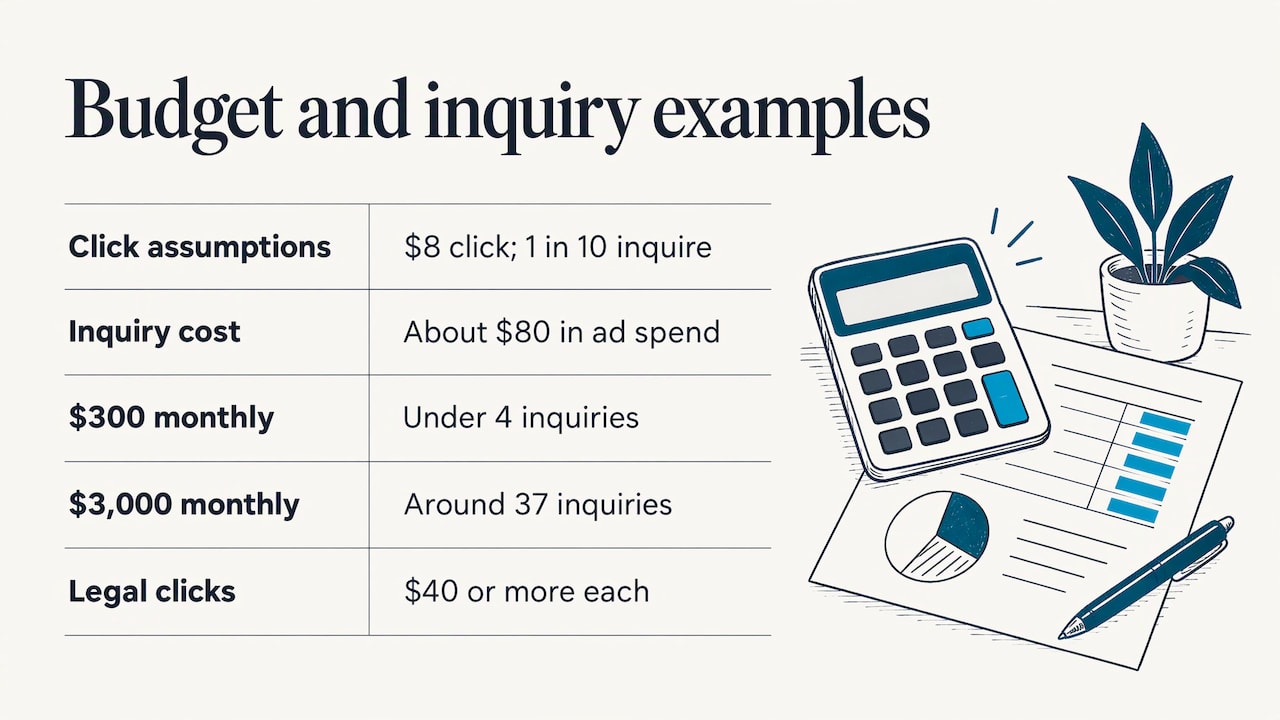
The honest arithmetic is click price against lead volume. Suppose a click in your market costs $8 and 1 in 10 clicks becomes an inquiry. Then each inquiry costs about $80 in ad spend before you count the management fee. On $300 a month, that is under four inquiries. On $3,000, it is around 37. If a plumbing emergency call or a signed remodel is worth hundreds or thousands of dollars, even small volumes can pay. But if your clicks cost $40 or more, as they can in competitive legal searches, a small budget buys only a handful of clicks, too few to learn from.
A practical way to size it: decide how many new customers a month you want, work out how many inquiries that takes at your normal close rate, and multiply by the cost per inquiry you can afford. That gives you a budget based on your numbers instead of a guess. Management fees then add a roughly predictable layer on top.
Note that the figures above are an illustration of the method, not market averages. Your own click prices and close rate will differ.
Fee ranges by business type in Palm Beach County and Florida
Here is how the models above tend to fit the local businesses we work with. These are planning examples built from the published ranges, not quotes.
Business
Typical setup
Model that usually fits
Plumber, one county, emergency and repair services
One to three campaigns, call tracking
Flat monthly fee
General contractor, several service lines
Campaigns per service, seasonal budget shifts
Flat fee or base plus percentage
Florida law firm, several practice areas
Campaign per practice area, intake tracking
Base plus percentage
Multi-location or eCommerce brand
Many campaigns, shopping and search
Percentage or base plus percentage
For plumbers and contractors, phone calls are the main result, so call tracking matters more than form fills. For lawyers, intake quality matters: a campaign that sends ten unqualified calls is worse than one that sends three real consultations.
How to judge a quote
When you hold a proposal, work through these questions.
What is the total monthly cost? Fee plus ad spend, in one number.
Is there a setup fee, and what does it cover?
Which tasks are included each month? Search-term reviews, ad testing, bid work and reporting should be named.
What is the contract length? Month-to-month terms and longer commitments are both common. Know which you are signing.
Who owns the account and the data? It should be you.
How will success be measured? Leads, calls and cost per lead, tied to tracking that is set up before launch.
What happens after the click? Ask who is responsible for the landing page.
Be wary of a fee so low it cannot cover real work, and of any quote that cannot explain what happens each month. A provider that talks about clicks and impressions but not leads is measuring the wrong thing.
Where Google Ads fits with SEO and AI search
Paid ads and organic search work together. Ads give you visibility quickly; search engine optimization builds visibility that does not need a click payment. Local search marketing helps a county-based business show up in map results. And AI-driven search such as Google AI Overviews and ChatGPT is changing how people find providers, which we cover in our AI search services. Many of our clients combine these rather than relying on one channel.
Working with IWD Marketing on Google Ads
IWD Marketing has been delivering web design and digital marketing since 1998 and is recognized as a top agency in South Florida. We take a results-oriented approach built around measurable outcomes, and our services span custom web development, SEO, pay-per-click and AI-driven search optimization. That means the website, the ads and the tracking can be handled by one team.
If you want a quote built around your own market and budget, start with our Google Ads and pay-per-click management page. We do not publish a fixed price, because the right fee depends on the factors above. Tell us your service area, your services and the number of customers you want, and we will scope the work from there. You can also see more about how we work on our FAQ page.
FAQ
How much does Google Ads management cost per month?
Most published guides put flat management fees between $200 and $4,000 a month, with most plans at $500 to $2,000. Percentage models use a share of spend, with 20% given as an example. The fee is separate from what you pay Google for clicks.
Is management fee included in the ad budget?
No. The ad budget is paid to Google. The management fee is paid to your provider. A total monthly cost is the two added together, so ask for both figures in any proposal.
Can Google charge me more than my daily budget?
On one day, a campaign can spend up to twice its average daily budget. Across the month, you will not pay more than 30.4 times that daily budget. So the daily figure you set defines your monthly ceiling.
Is $500 a month enough for Google Ads?
It can run a small, tightly targeted campaign, for example one service in one city. Whether it produces enough leads depends on your click prices and how many clicks turn into inquiries. In competitive categories, a larger budget gives you more data and more chances to win customers.
Should I pay a flat fee or a percentage of spend?
A flat fee is easier to plan for and suits steady local budgets. A percentage or base-plus-percentage model suits accounts that grow or change with the season. Choose the one whose scope is clearly written down.

 Responsive Web Design
 Content Management Systems
 eCommerce
 Web Maintenance
 Web Hosting
 Web Accessibility


 SEO Search Engine Optimization
 PPC Pay-Per-Click
 SERM Search Reputation
 Local Search
 Social Media
 Mobile Marketing
 Content Marketing