Custom website development means a site designed and built around your business: your services, your customers, your service area and your sales process. It is not a theme with your logo dropped in. For a Florida law firm, a Palm Beach County plumber or a contractor who lives on phone calls and quote requests, the practical question is what the build will include, how long it takes and what it costs. This guide answers those questions. We have built websites since 1998, and the process below is the one a business should expect from any serious team.
Iwdesigners
Build a Website Around Your Business
IWD Marketing has delivered custom web development since 1998, with responsive design and digital marketing solutions tailored to business needs.
A custom website is planned, designed and coded for your business goals, so structure, speed, content tools and conversion paths fit how you actually win customers.
A sound process runs in six stages: discovery, structure, design, development, testing and launch, then ongoing maintenance.
Price depends on scope: number of page types, integrations, eCommerce, content management needs, accessibility work and who writes the content. Ask for a scoped proposal, not a flat guess.
User experience is measurable: page speed, mobile layout, clear navigation and one obvious next step per page.
Search and AI visibility should be built in from the start, not added after launch.
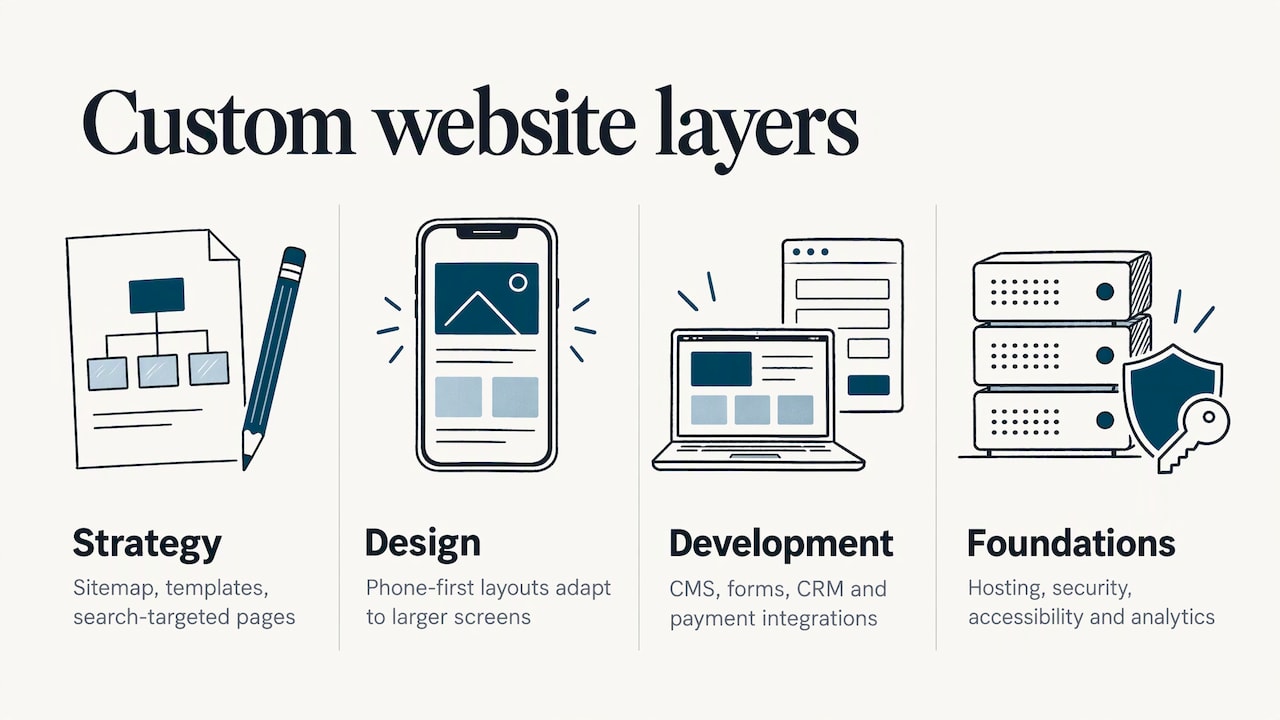
A custom build has four layers, and each one is a decision rather than a default.
Strategy and structure. Who visits, what they want and what you want them to do. This produces a sitemap, page templates and a plan for which pages target which searches.
Design. Layouts drawn for your content and your brand, for phones first and then larger screens. This is where responsive web design matters: one site that rearranges itself properly on any screen instead of a separate, cut-down mobile version.
Development. The code, the content management system your team uses to edit pages, forms, integrations with your CRM, scheduling or payment tools, and, when you sell online, a custom shopping cart.
Foundations. Hosting, security, accessibility, analytics and the technical SEO elements such as clean URLs, page titles, structured data and fast loading.
Templates and page builders can put a site online quickly, and for a first presence they are a reasonable starting point. A custom build is what you choose when the site has to carry real revenue: when you need specific page types (practice areas, service cities, project galleries), unusual forms or integrations, or full control over performance and search structure.
The custom website process, step by step
The steps below are the sequence a business should expect. At each one we note where projects go wrong and what we do about it.
1. Discovery
This is a working session on your goals, your best customers, your competitors and what the current site does or fails to do. Projects go wrong here when the brief is “make it look modern” with no measurable goal. A better brief names the result: more quote requests from Palm Beach County, more consultations from a specific practice area, more online orders.
Our approach is results-oriented and built around measurable outcomes, so we begin by agreeing what will be measured.
2. Structure and content plan
Before any design, the site map is drawn: which pages exist, how they link and which search each page is meant to answer. A plumber might need separate pages for water heater repair, repiping and emergency service, each with the towns served. A law firm needs a page per practice area and a profile per attorney. Skipping this stage is the most common reason a good-looking site never ranks.
Content is the bottleneck that delays most launches. Agree early who writes the copy, who supplies photos and who approves. Our content marketing work can cover the writing so the schedule does not stall on it.
3. Design
Design starts with the key pages (home page, a service page, a contact page) and is reviewed on a phone as well as a desktop. Ask to see layouts at phone width, not only a desktop mockup. Most local searches happen on phones, and a layout that only works on a monitor fails the people most likely to call.
4. Development
Designs become working pages inside your CMS. Developers build the templates, forms, tracking and integrations, and connect the site to hosting. Good practice is a private staging copy where you can click through the real site before anyone else sees it.
5. Testing and launch
Testing covers more than “does it look right.” Check every form delivers to the correct inbox, phone numbers are tappable on mobile, page speed is acceptable, old URLs redirect to new ones so existing search rankings are not lost, and the site passes accessibility checks. Redirects are the step teams forget most often, and forgetting them can erase years of visibility.
6. Maintenance and growth
A site is not finished at launch. Software needs updating, forms need monitoring and content needs refreshing. Website maintenance and web hosting keep the site secure and online, and SEO and advertising turn it into a lead source.
What custom website development costs
No honest agency can quote a number without knowing the scope, and prices differ widely between a ten-page service site and a store with hundreds of products. We do not publish fixed prices because projects differ so much. What you can do is understand what moves the price, so you can compare proposals fairly.
Cost driver
Why it changes the price
Number of unique page types
Each template (service page, attorney profile, project gallery) is designed and built separately
Content management needs
A simple editor is faster to build than custom fields, filters and role permissions
eCommerce
Product catalogs, checkout, shipping, tax and payment integrations add build and testing time
Integrations
CRM, scheduling, quoting, payment and review tools each need connection and testing
Content creation
Copywriting, photography and video are either included or supplied by you
Accessibility
Building to a recognized standard is cheaper at the start than retrofitting
Migration
Moving content and keeping old URLs working takes planning
Ongoing services
Hosting, maintenance, SEO and advertising are usually separate monthly work
When you compare proposals, check that each lists the same deliverables. A low quote that leaves out content, redirects, accessibility or hosting is not lower; it simply moves cost to later. A good proposal states the page types, the integrations, who writes the content, the timeline and what happens after launch.
User experience: the part visitors actually judge
User experience, or UX, is how easy it is for a visitor to find what they came for and take the next step. For a business site, that step is usually a call, a form or a purchase. A few practices carry most of the benefit:
One clear action per page. A plumber’s emergency page should lead with the phone number. A law firm’s practice page should lead with how to book a consultation.
Navigation that matches how people think. Name menu items for what customers search (“Water Heater Repair”), not internal jargon.
Mobile-first layouts. Buttons large enough to tap, text readable without zooming, forms short enough to finish on a phone.
Trust signals where decisions happen. Licenses, reviews, case results and real photos near the contact button, not buried in an About page.
Accessible design. Sufficient contrast, labeled form fields, keyboard navigation and text alternatives for images help every visitor and are the basis of web accessibility compliance.
These are measurable. Track form submissions, tracked calls and the pages where visitors leave, then adjust. That feedback loop is what separates a site that earns from one that merely exists.
Accessibility belongs in the build
The U.S. Department of Justice publishes guidance on web accessibility under the ADA explaining that businesses open to the public should make sure their websites do not shut out people with disabilities. For Florida businesses, particularly law firms and contractors who serve the public, the cheapest time to address this is during the build, when contrast, headings, form labels and keyboard navigation are designed in. We offer web accessibility work as part of site builds. For questions about your legal obligations, speak with your attorney.
Build search and AI visibility in from day one
A website is only valuable when the right people find it. Custom development lets search be part of the architecture: dedicated pages for each service and city, clean code, structured data and fast load times. Local businesses also need consistent business listings and reviews, which is the focus of local search marketing.
Search is also changing. People now ask ChatGPT, Gemini, Perplexity and Google’s AI features for recommendations, and those tools draw on clearly structured, trustworthy pages. We offer AI search optimization so your site is organized to be understood and cited by these systems, alongside traditional SEO. Planning this at the structure stage is far simpler than rewriting a finished site.
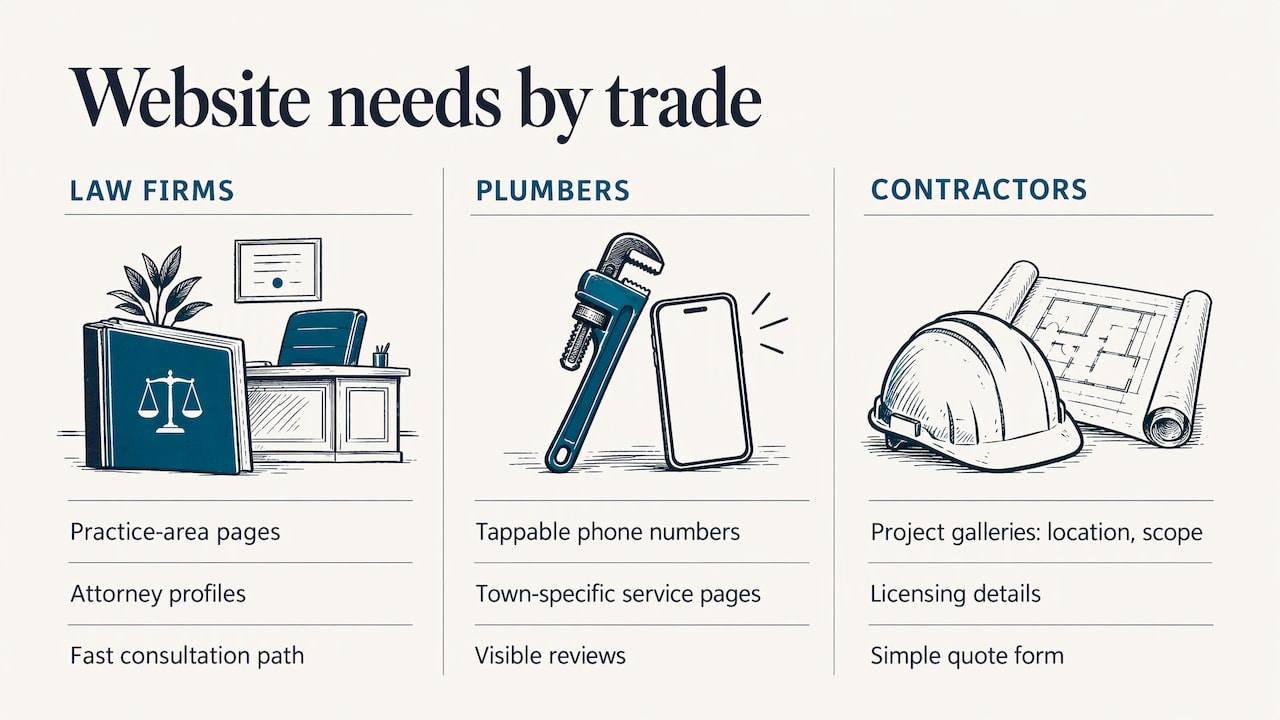
What this means for lawyers, plumbers and contractors
Law firms. Visitors compare several firms in minutes. Your site needs a page per practice area, attorney profiles, plain-language explanations and a fast consultation path. We cover this in more detail in our guide to law firm website design.
Plumbers. Most searches are urgent and on a phone. Tappable numbers, service pages per town (Boca Raton, Jupiter, Palm Beach Gardens, Stuart and the rest of your area) and visible reviews do the work.
Contractors. Buyers want proof. Project galleries with locations and scope, licensing details and a simple quote request form turn a visit into an estimate.
In each case the pattern is the same: structure the site around the questions your customers ask, then make the next step obvious.
How to choose a custom web development partner
Use these criteria to compare proposals:
Measurable goals. Do they ask what result you need and how it will be tracked?
Complete scope. Page types, content, integrations, accessibility, redirects, hosting and training are all listed.
Real examples. Sites for businesses like yours, with outcomes, not only screenshots.
Search and AI built in. Structure for search is part of the plan, not an optional extra.
A clear plan for after launch. Maintenance, hosting, updates and marketing are defined.
Ownership and access. You should have access to your content, domain and analytics.
How we approach it
IWD Marketing has designed and developed websites since 1998 and is recognized as a top agency in South Florida. Our custom web design covers responsive design, content management systems, eCommerce, accessibility, hosting and maintenance, and it connects to SEO, PPC, local search and AI search optimization, so the site and the marketing around it are planned together. See our custom web design services or start from iwdesigners.com to talk through your project.
If you sell products, our eCommerce development builds custom shopping carts around your catalog and checkout.
FAQ
What is custom website development?
It is the process of designing and coding a website specifically for one business, rather than adapting a ready-made theme. Structure, layouts, features and content tools are planned around your goals and customers. The result is a site you control and can grow.
How long does a custom website take?
Timelines depend on the number of page types, integrations and how quickly content and approvals arrive. Content is the most common cause of delay. A written scope with milestones gives you a realistic schedule for your project.
How much does a custom website cost?
It depends on scope: page types, content management needs, eCommerce, integrations, content creation and accessibility. Ask for a scoped proposal that lists each deliverable so you can compare quotes on equal terms. Hosting and maintenance are usually separate ongoing items.
Do I need a custom site if I am a local contractor or plumber?
If your business depends on local leads, a custom site gives you service and city pages, fast mobile performance and quote or call paths built for your work. That structure is what helps you show up when nearby customers search.

 Responsive Web Design
 Content Management Systems
 eCommerce
 Web Maintenance
 Web Hosting
 Web Accessibility


 SEO Search Engine Optimization
 PPC Pay-Per-Click
 SERM Search Reputation
 Local Search
 Social Media
 Mobile Marketing
 Content Marketing